|
Present 'Unresolved' Problems
Unresolved 'Difficulties and Obstacles'-
Illustrations
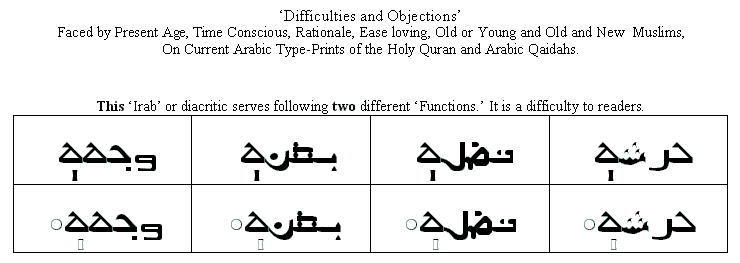 [For your understanding above two functions have been shown in different colors.]
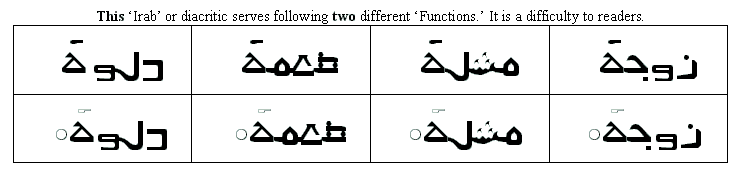 [For your understanding above two functions have been shown in different colors.]
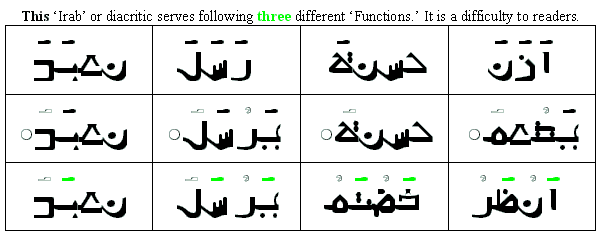
[For your understanding above three functions have been shown in different colors.]
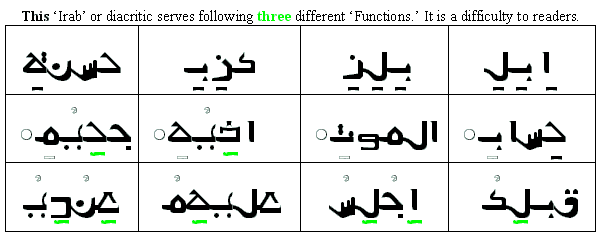
[For your understanding above three functions have been shown in different colors.]
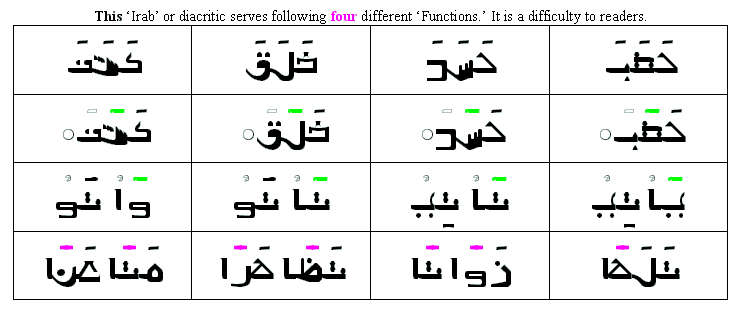 [For your understanding above four functions have been shown in different colors.]
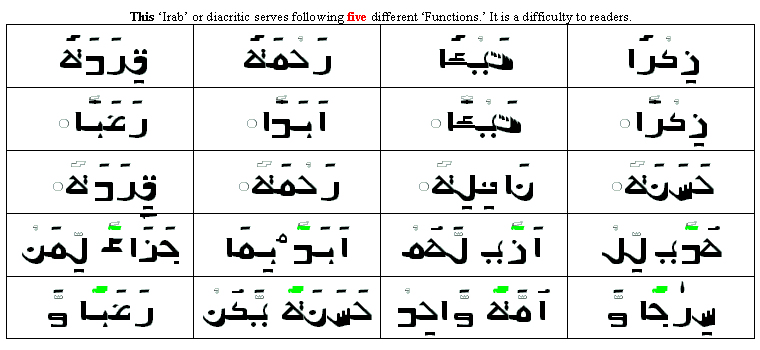 [For your understanding above five functions have been shown in different colors.]
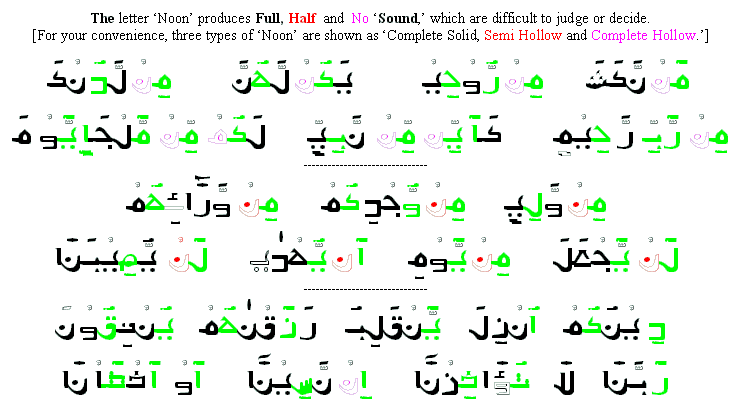 [For your understanding above three functions have been shown in different colors.]

|
Unresolved 'Difficulties'of Learners and Professionals
1-2. Too
many symbols, too many resembling symbols and too much resemblance:
Too many symbols, too many resembling symbols and too much resemblance
with in the symbols make it extremely confusing and disturbing to English
knowing learners, during their learning the recitation skills of the
Holy Quran and during their subsequent practice.
English Alphabet is found in two 'cases.' These are 'Upper case' and 'Lower case.'
Arabic Alphabet is found and printed using four cases or types. There are four different shapes or styles for Isolated Characters, Initial or Start Position Characters or Symbols, Inner Position Characters or Symbols and Last or Final Position Characters or Symbols. Not only the gross number of shapes, styles or symbols in above mentioned four positions exceeds 120, but also over 80 of them possess deep mutually resembling shapes and styles.
| Q |
Can readers effort, time, chaos and fatigue be curtailed? Can
Arabic be printed with just one symbol per letter (like Upper
Case English) and each symbol be distinct and easy to be judged? |
| A |
Yes. In this age of computers, Arabic text can be printed with
just one symbol per letter and each symbol can be made distinct
and much more easy to be judged? |
See Single Case Arabic Font and its samples.
3. Deciding the Classification of Letters with in a Traditional Arabic Text:
The readers of the past examined each letter in the text for its classification or role. Was the letter to be sounded or pronounced individually, or blended with the next (spoken) letter or to be just ignored?
Based on their knowledge of 'Rules of Recitation' and the 'Accumulated
Experience,' they made their evaluation, as to which of the following
four categories each letter belonged.
- First letter of a pair of spoken letters, blending with the next spoken letter,
- Second letter of a pair of spoken letters, not blending with the next spoken letter,
- An Independent (self-spoken) letter, not part of a pair of spoken letters,
- A Non-spoken letter or a No-sound letter, or a Saqit letter, not to be sounded.
| Q |
Can their effort and time, to decide the category or role of each and every letter, be saved and their frustration be eliminated? |
| A |
Yes. In this age of computers, Arabic letters can be printed in different colors to display the category or role of each and every letter, for all types of readers.
Let the 'colors' and not the readers, decide the 'classification' of the letters. |
See the 'Solution' after the current page.
4. Deciding the Classification of Diacritics in a Traditional Arabic Text:
The readers of the past examined each diacritic associated with the letter, for its classification. Was the diacritic to be obeyed fully or partially or just to be ignored?
Based on their knowledge of 'Rules of Recitation' and the 'Accumulated
Experience,' they made an evaluation, as to which of the following
five classes that diacritic belonged.
- Fully effective blending diacritic, on the letter, blending to next spoken letter,
- Half effective blending diacritic, on the letter, blending to next spoken letter,
- Fully effective diacritic, on the letter, not blending to next spoken letter,
- Half effective diacritic, on the letter, not blending to next spoken letter,
- Not-effective diacritic, or a Saqit diacritic.
| Q |
Can their effort and time, to judge and classify each and every diacritic for its full, partial or nil command, be curtailed and their frustration be eliminated? |
| A |
Yes. In this age of computers, Arabic diacritics can be printed in different colors to show the category or role of each and every diacritic, for all types of readers.
Let the 'colors' and not the readers, decide the 'classification' of the diacritics. |
See the 'Solution' after the current page.
5. Jazm, Shadda and Idgham, their relative location and their reverse usage:
The contemporary type-faces place or fix the signs of Jazm, Shadda and Idgham, at least one letter away (or past, or beyond) the letter, from where the 'Blending' of sounds of two letters is to commence.
From that (later) letter, these signs give the actual direction (or order or signal) to blend together the former (or previously gone by) letter to the later letter. So, the readers get the required order to blend the two letters, when they have actually passed the first of the two letters and reached the last letter.
The second (spoken) letter may be available 1-5 letters away, on next line or next page.
Present-day students condemn and forbid this non-logical way of working. They feel that, placing or fixing of Jazm, Shadda and Idgham signs, at the later letter, reflects an after thought, a delayed action, or a post accident cry for caution.
Many keen students earnestly wish that they should be given the green signal at the former or the first letter of the pair, from where actual blending commences and not where the actual blending concludes.
| Q |
Can their psyche and sanity be safe guarded and their agony and torture be avoided? |
| A |
Yes. By color coding the letters and diacritics, as explained above, all types and grades of readers can be given (doubly) green signal at the former letter and its diacritic, from where the actual blending of the two letters of a pair commences.
Let the readers not learn about and search around for Jazm and Shadda and obey them in reverse. |
See the 'Solution' after the current page.
6. Awareness of Words, to be recited More-closely, One after the other:
In the Holy text some words are recited individually and some words have to be recited more closely joined together. In a traditional typeface, the readers have to invest lot of their effort and time to identify the two types of words cited above.
Consequently, the readers commonly misstep, stumble and make mistakes; either not reciting the words more-closely when so required, or attempting to recite them too-closely when not required as such.
| Q |
Can their effort and time, to identify the two types of words, defined above, be saved or curtailed? |
| A |
Yes. In this age of computers, to create a difference between the two types of words defined above, one of them, which is to be recited more closely joined together, can be crowded together and even underlined, to lead the readers. |
See the 'Solution' after the current page.
7. Blending two Letters, located on two lines:
The contemporary type-faces require the readers to blend together the 'last (spoken) letter' on one line with the 'first (spoken) letter' on the next line.
Although, about 20 % lines require such blending, yet Arabic Language offers no facility like 'a hyphen in English'. Consequently, their readers trip and stumble frequently and often make mistakes; either not blending at the right places or attempting to blend at the wrong locations.
| Q |
Can their tripping and stumbling be, altogether, eliminated? |
| A |
Yes. Their tripping and stumbling can altogether be eliminated. |
See the 'Solution' after the current page.
8. Decoding 'Punctuation Sign(s)' in Traditional Arabic Text and Obeying them:
Arabic Punctuation Signs are neither 'Graphical' in nature nor 'International' by any standard. These signs are fully based on Arabic vocabulary and terminology. The readers of the past had to develop some Arabic know how to decode them. It was, and still is, a big drudgery.
It is extra strange for English knowing persons to find that, more than one 'Punctuation sign' are posted at one location, in the text.
For the readers,the Arabic Punctuation Signs can be grouped under following categories.
|
|
NO-Stopping Sign. |
Keep moving with your Recitation. |
|
|
May Stop or May Not Stop Sign. |
Choice is with the reader. |
|
|
Stop Sign. |
Stop and then start at next sentence / letter. |
|
|
Pause a bit (less than a Stop). |
Start at next sentence / letter. |
|
|
More than one of the above Signs, put together. |
Choice is with the reader. |
|
|
More than two of the above Signs, put together. |
Choice is with the reader. |
| Q |
Can the non-Arab, non-literate in Arabic, English knowing readers, ever recite the Holy Quran, without the drudgery and slavery of non international, non graphical complicated Arabic Punctuation Signs? |
| A |
Yes. Not only the non-Arab, non-literate in Arabic, English knowing readers, but also all other types and classes of readers, shall, inshallah, recite the Holy Quran, without non international, non graphical complicated Arabic Punctuation Signs. |
See the 'Solution' after the current page.
|



